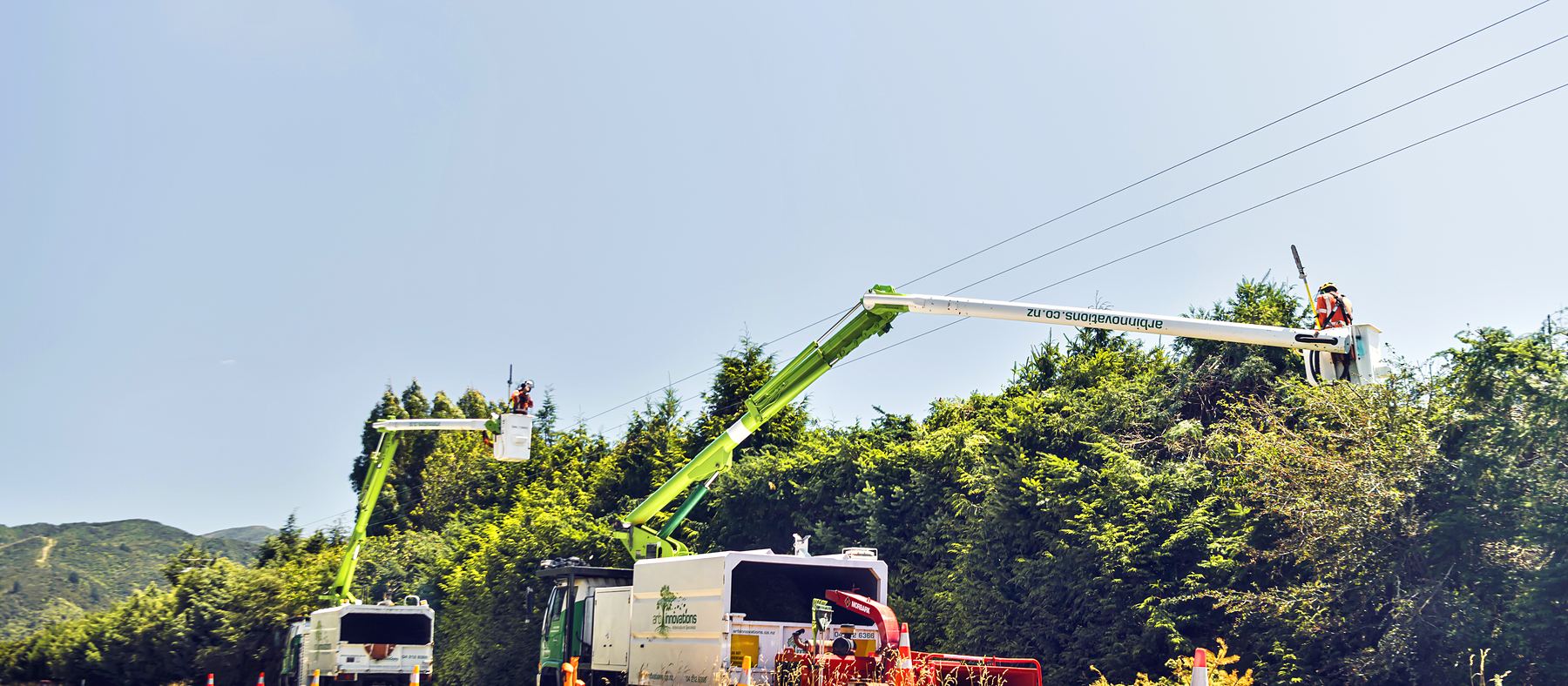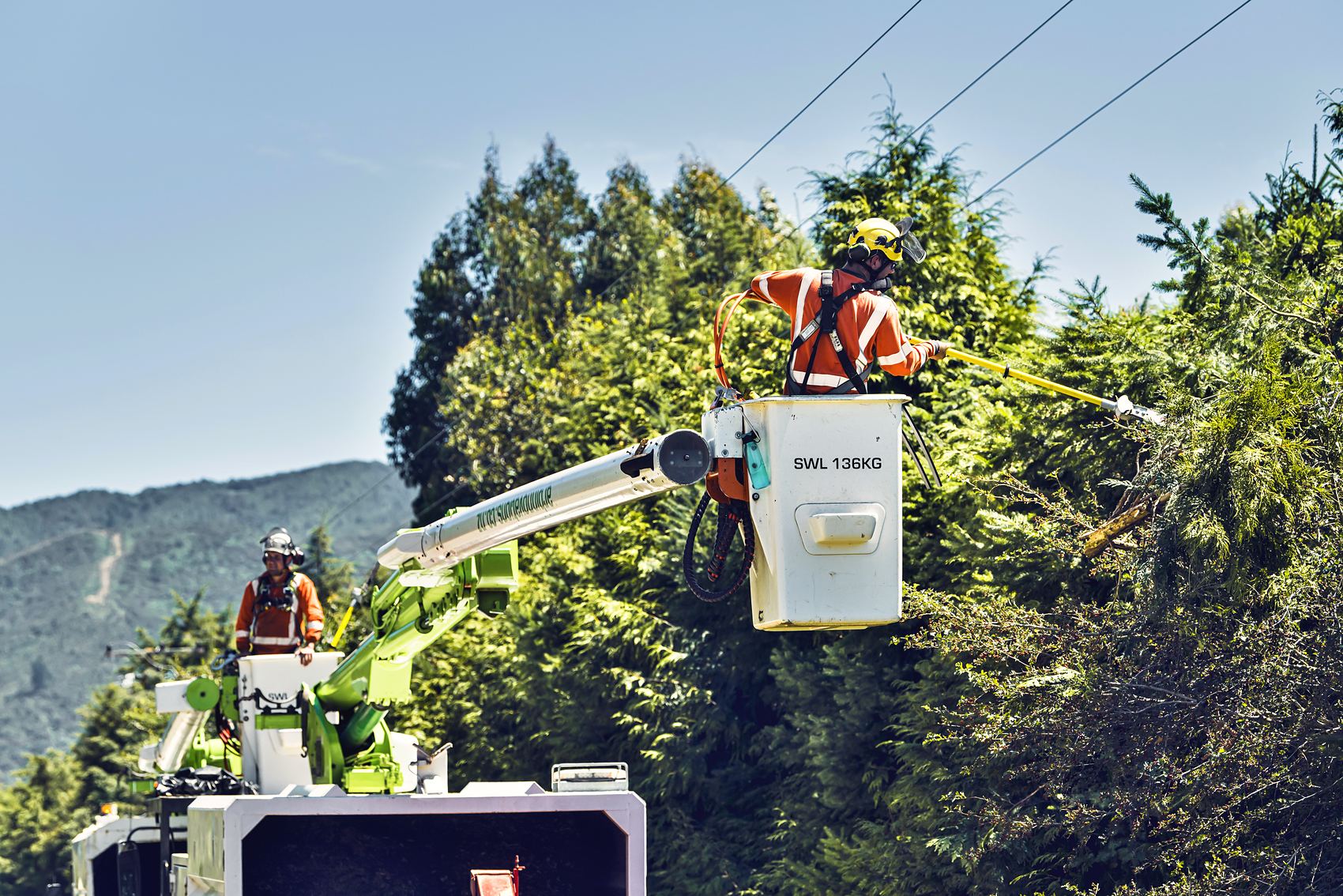
Two Arb Innovations elevated work platforms working a line through roadside trees

Tree work near power lines

Trees within four metres of a power line may only be cut by a contractor the network operator has approved. We hold that approval on both networks covering the lower North Island.

The short version

If it's within four metres of a line, it's not a normal tree job.

New Zealand law treats trees near power lines as a separate class of work. Under the Electricity (Safety) Regulations 2010, work within four metres of network lines may only be carried out by a contractor the network operator has approved. Do it yourself and you risk prosecution — and, far more seriously, electrocution.

Keeping trees clear of lines is the property owner's legal responsibility under the Electricity (Hazards from Trees) Regulations 2003. That responsibility doesn't move just because the tree was there first, or because it self-seeded.

Arb Innovations holds approval on both networks that matter across the lower North Island. That means one contractor can handle your trees whether you're in Karori, Carterton or Linton.

Wellington Electricity

Network Authorised Vegetation Contractor

High voltage and low voltage — close work within 4 metres

Wellington Electricity places contractors in tiers according to what they are authorised to work on. We hold the top category, covering both high and low voltage close work. Only three contractors are listed in that category on their current schedule.
Wellington · Lower Hutt · Upper Hutt · Porirua

Powerco

Approved tree contractor

Listed across three network regions

Powerco publishes the contractors approved to work near its network. We are listed for the Wairarapa, Manawatū (including Taihape and Raetihi) and Whanganui regions, and can be engaged directly against a Cut or Trim notice.

Wairarapa · Manawatū · Whanganui

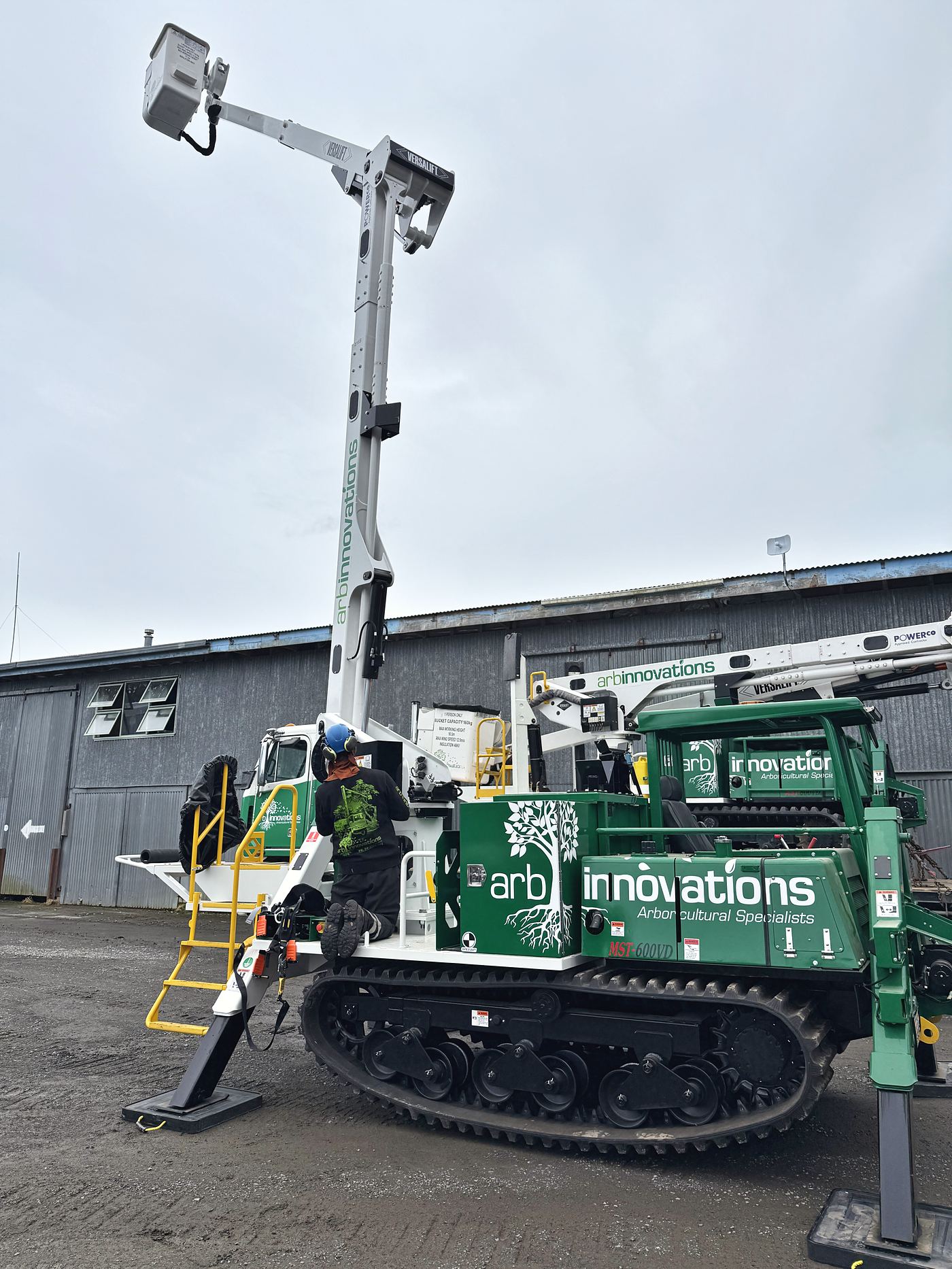
An Arb Innovations Marooka tracked elevated work platform with its insulated boom extended, in the yard

Purpose-built plant

Marooka platforms, built for this work and nothing else.

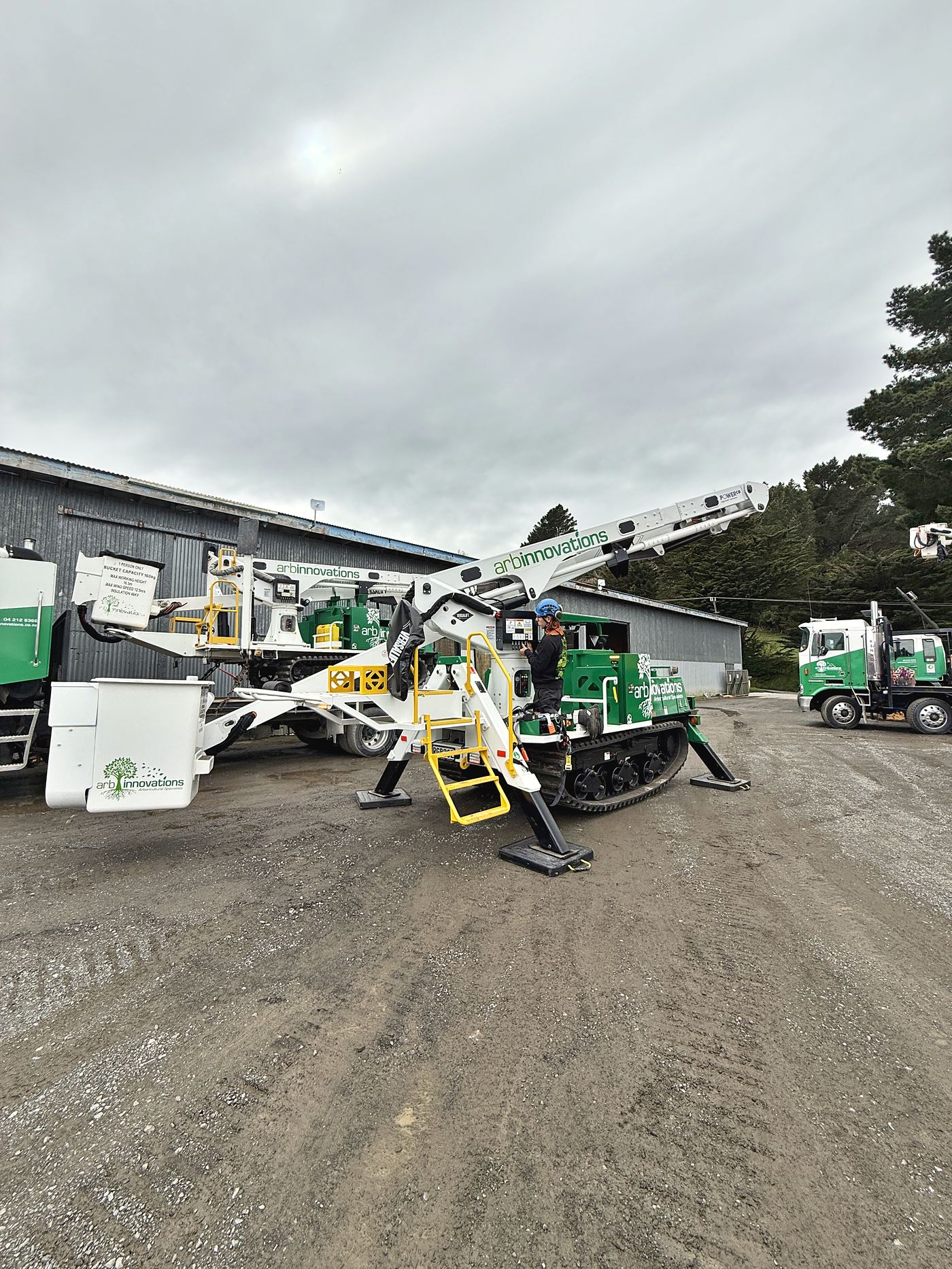
Our Marooka elevated work platforms are bespoke units — specified and built for live line vegetation work rather than adapted from a general-purpose machine. Insulated boom, tracked undercarriage, and a working envelope that suits the clearances this work has to be done to.

The specification is what earns its keep on a hard site. Tracks put the platform on wet ground, steep berms and soft paddocks a truck-mounted unit simply cannot reach, and get it there without cutting up the surface on the way in.

The fleet

More than one, which matters on a network callout.

Running several platforms means a job does not wait on one machine coming free, and a long span of line can be worked from both ends at once.

They mobilise off our own yards at Judgeford, Waingawa and Linton, so getting a machine to the Wairarapa or the Manawatū is our scheduling problem rather than a hire company's availability.

Two Arb Innovations Marooka tracked elevated work platforms alongside the line trucks at the yard

Clearance zones

How close a tree may legally grow.

Three zones apply to every overhead line, and they widen as voltage rises. The growth limit zone is the space no part of a tree may enter. The cut-back zone is how far back we cut so the tree doesn't re-enter that space before the next inspection. The notice zone is the distance at which the network operator will write to you.

Overhead line voltageGrowth limitCut-backNotice
Low voltage lines (230–400V)0.5m1.5m2.5m
High voltage (6.6kV)1.6m2.6m3.6m
High voltage (11kV)1.6m2.6m3.6m
High voltage (33kV)*2.5m3.5m4.5m
High voltage (50–66kV)*3.0m4.0m5.0m
High voltage (66kV or more)*4.0m5.0m6.0m

* Clear to the sky: the growth limit zone for these lines reaches vertically with no upper limit. Trees protected by a district plan are excluded from that requirement. Spans longer than 150 metres carry additional clearances again. Figures published by Powerco; the Wellington Electricity network applies the same four-metre rule for close work. If you're unsure which applies to your property, ask us and we'll confirm it.

Planting

Before you plant, look up.

The cheapest tree work near a line is the tree nobody planted under it. Powerco recommends keeping new plantings at least 30 metres clear of power lines, and choosing species whose mature height suits the distance you actually have.

Species selection catches people out. Something sold as a garden tree can still make twelve metres, and the label rarely says so. Ask us before it goes in the ground rather than after it becomes a notice — that conversation is free.

Coming changes

The rules are tightening, in stages.

The Electricity (Hazards from Trees) Amendment Regulations 2026 came into force on 23 July 2026 and phase in over the following two years. Three changes will matter to landowners, and none of them apply yet except the first:

  • Clear to sky extends to smaller lines. From 16 October 2026 the growth limit zone reaches vertically with no upper limit for lines of 11kV and below in non-urban areas, matching the rule already applying to larger lines.
  • A low height planting zone. Expected from 2027. Within 24 metres either side of a line, on non-urban land that is not already forest, new plantings will need a mature height lower than their distance from the line — so that a tree which fails cannot reach the conductor.
  • Treefall hazard notices. Expected from 2028. A lines owner will be able to require removal of a tree within 24 metres of the growth limit zone that it has assessed as a moderate or high treefall hazard. The assessment must be based on the advice of a qualified arborist, and the lines owner meets the reasonable cost of the removal.

Dates and detail here follow the Government's announcement and Cabinet papers. The networks will publish their own guidance as each stage commences, and we will tell you what actually applies to your property when we quote it.

Cut or Trim notices

Who pays, and what you actually have to do.

Network operators inspect their lines and write to tree owners when something is encroaching. The letter tells you what's required and by when. There are two kinds and the difference is money.

First cut — the network pays

Powerco calls this PPPD: Powerco pays, Powerco does. If those trees have not been cut before, the cost of the first trim is covered. Contact the contractor named on the notice and they'll arrange it with you.

Second and later cuts — you pay

Called TOP: tree owner pays. Once a tree has been cut once, keeping it clear is on you. You may approach any approved contractor for a quote — including us.

Don't sit on it. Powerco advises that failing to act within the timeframe can bring a fine of up to $10,000 and a further $500 per day until the work is done, plus liability for any damage your tree causes to the network.

Bring us the notice. We'll read it, tell you which type it is, quote the work, and where a shutdown is needed we'll talk you through arranging it with your retailer.

How we work

What a line-clearance job looks like.

  • Assessment. A qualified arborist identifies the line, its voltage and the zones that apply, then confirms whether the work sits inside the four-metre rule.
  • Approvals and shutdowns. Where the job needs the line de-energised, we tell you what to ask your retailer for, and when. Retailers need at least 24 hours' notice. Where a Close Approach consent is required, we arrange it.
  • Traffic and public safety. Street trees mean traffic management, pedestrian control and neighbour notification. We plan it before we arrive, not on the day.
  • The cut. Directional pruning that respects the tree's structure. Line clearance is not an excuse to butcher a tree — a well-cut tree stays out of the lines longer and doesn't fail into them later.
  • Clean-up and record. Arisings chipped and removed, and a written record of what was done and when the next cut is likely due.
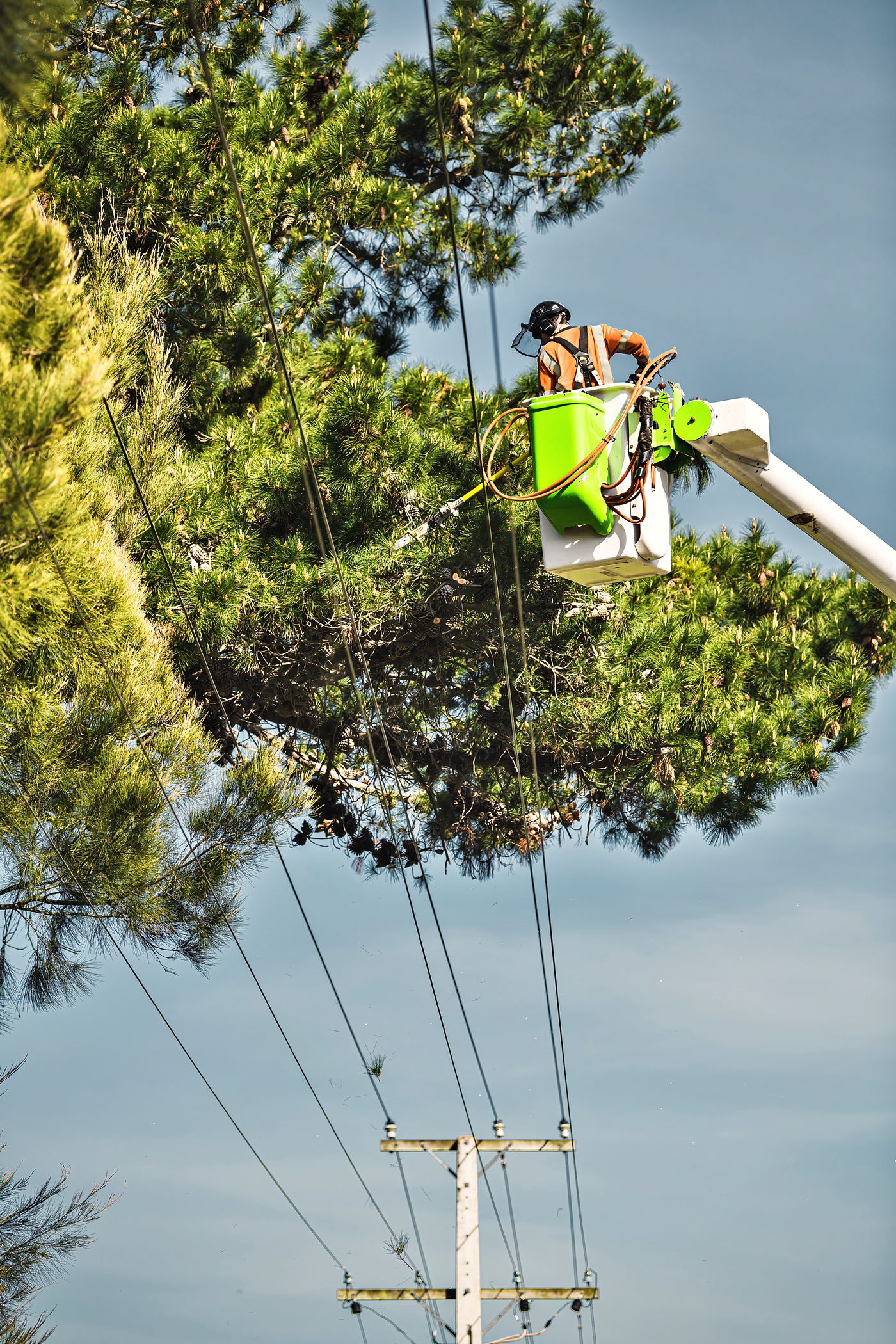
An Arb Innovations arborist working from an elevated platform high in a pine, with conductors running below

Close work

Four metres is closer than it sounds.

Working inside the approved distances means every cut is planned around where the conductor is, not just where the branch is. The platform is positioned so that the operator, the saw and the limb being cut all stay outside the limit for the voltage on that line.

That is precisely why network operators approve contractors individually instead of accepting any qualified arborist.

Reach over proximity

Most of it is done on an insulated pole saw.

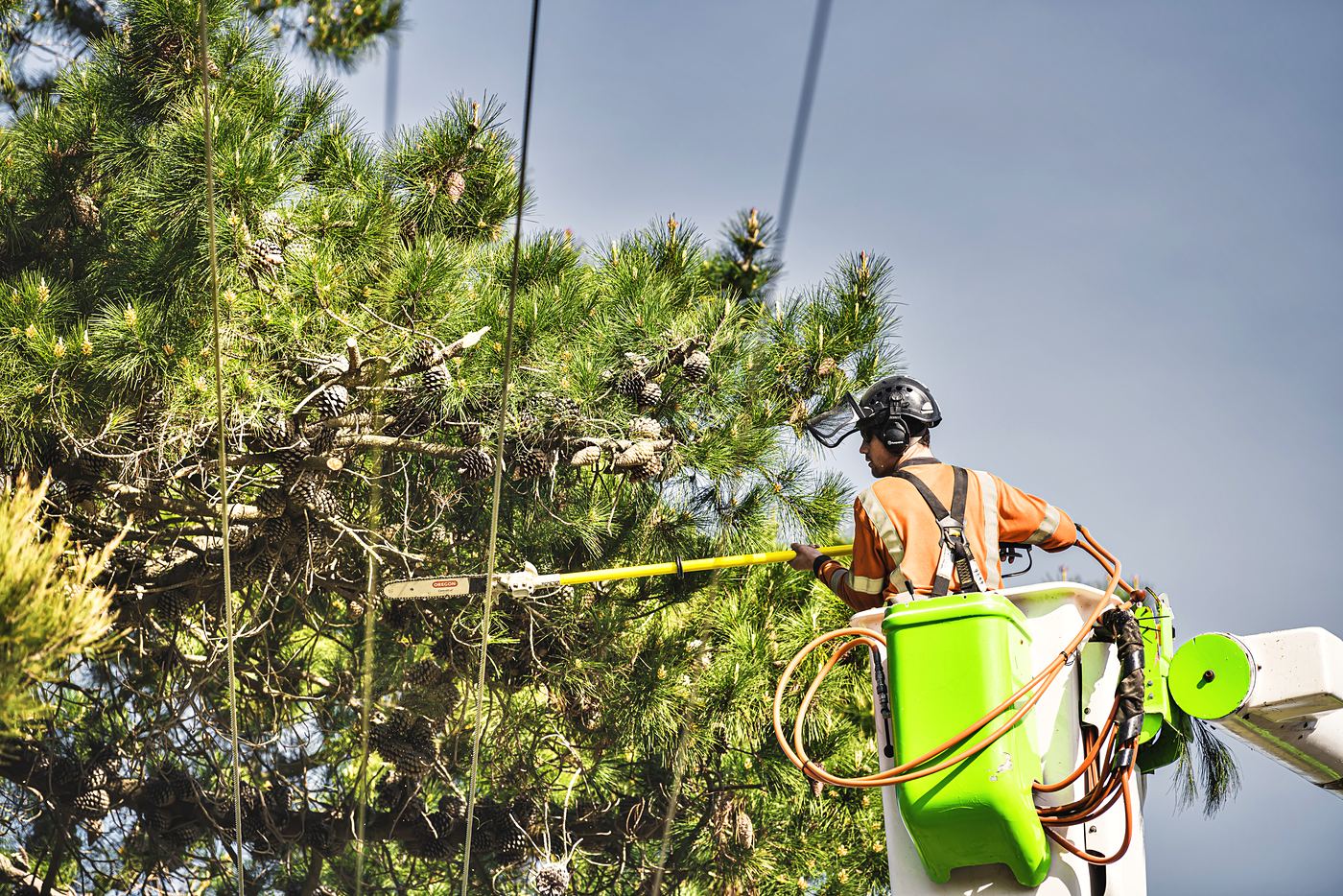
Close-quarters cutting near a line is pole saw work, and these are not ordinary pole saws. They are hydraulic, insulated tools built specifically for vegetation work around live conductors — the insulation is part of the safe working system, not an accessory to it.

They also keep the operator further from the conductor than a handsaw ever would, and let the cut be made at the angle the branch needs rather than the angle the bucket allows.

Small material drops clear. Anything with weight in it is roped and lowered — nothing comes down through a line.

An Arb Innovations arborist making a cut with a pole saw from an elevated platform beside overhead lines

Emergency

A branch on the line, or a line on the ground.

Treat every downed or low-hanging line as live. Keep people, children and animals well clear, don't attempt to move anything, and don't drive over a fallen line.

Once the network operator has made the site safe, we can clear the tree. If a storm has brought a tree down across your property and lines are involved, call the network first — then call us.

Common questions

Frequently asked

Can I trim a tree near power lines myself?

No. Under the Electricity (Safety) Regulations 2010 you can be prosecuted for carrying out tree work yourself within four metres of network power lines. Any tree within four metres must be cut by an approved contractor. Beyond four metres, any qualified arborist may carry out the work.

I've received a Cut or Trim notice from Powerco. What now?

There are two kinds. A 'Powerco pays Powerco does' (PPPD) notice means it's the first time those trees have needed cutting, and Powerco covers the cost — contact the contractor named on the notice. A 'Tree owner pays' (TOP) notice means it's a second or subsequent cut and the cost sits with you as the tree owner, so you may approach any approved contractor for a quote. We are an approved contractor for Powerco in the Wairarapa, Manawatū and Whanganui regions.

What happens if I ignore a Cut or Trim notice?

If you don't act within the timeframe given, Powerco advises you can be fined up to $10,000, plus a further $500 per day until the work is completed. You may also be liable for the cost of any damage your tree causes to lines or equipment.

Does the power need to be switched off?

Sometimes. Where the work requires it, your electricity retailer — the company you pay your power bill to — arranges a temporary disconnection. They need at least 24 hours' notice. We'll tell you at quoting stage whether it's necessary and talk you through arranging it.

How close is too close?

It depends on the voltage. For standard 230–400V lines the growth limit zone is 0.5m and the cut-back zone 1.5m. For 11kV high voltage it's 1.6m and 2.6m. For lines of 66kV and above it rises to 4m and 5m. The full table is on this page.

What if the tree was self-seeded, or I never expected it to reach the lines?

You may be able to declare 'no interest' in the tree. That hands responsibility to the network operator, who will then trim or remove it at their discretion — or may choose not to work on it at all. Powerco and Wellington Electricity both have a process for this.

Who do I call if a line is down or a branch is on the lines?

Keep people and animals well clear and call immediately. Powerco's emergency line is 0800 27 27 27. In the Wellington Electricity network area call their fault line. If anyone is in danger, call 111. Never approach a downed line.

Free quote

Tell us about your tree.

A qualified arborist will visit, assess and quote — no charge, no obligation.

  • Quoted and assessed by a qualified arborist, every time
  • Fully insured · ISO 9001, 45001 and 14001 · SiteWise Gold
  • Residential, commercial, council and development work
Or call 04 212 6366 Wellington Head Office
04 390 0513 Wairarapa Office
06 353 0632 Manawatu Office
0800 272 583 Toll Free 0800 ARB LTD
 
Address
Maximum 10 files.
5 MB limit.
Allowed types: gif jpg jpeg png.